
What is AI UGC? A practical guide for brands
AI UGC is user-generated-style content made with AI avatars instead of human creators. Here is how it works, when it outperforms, and how brands run it.
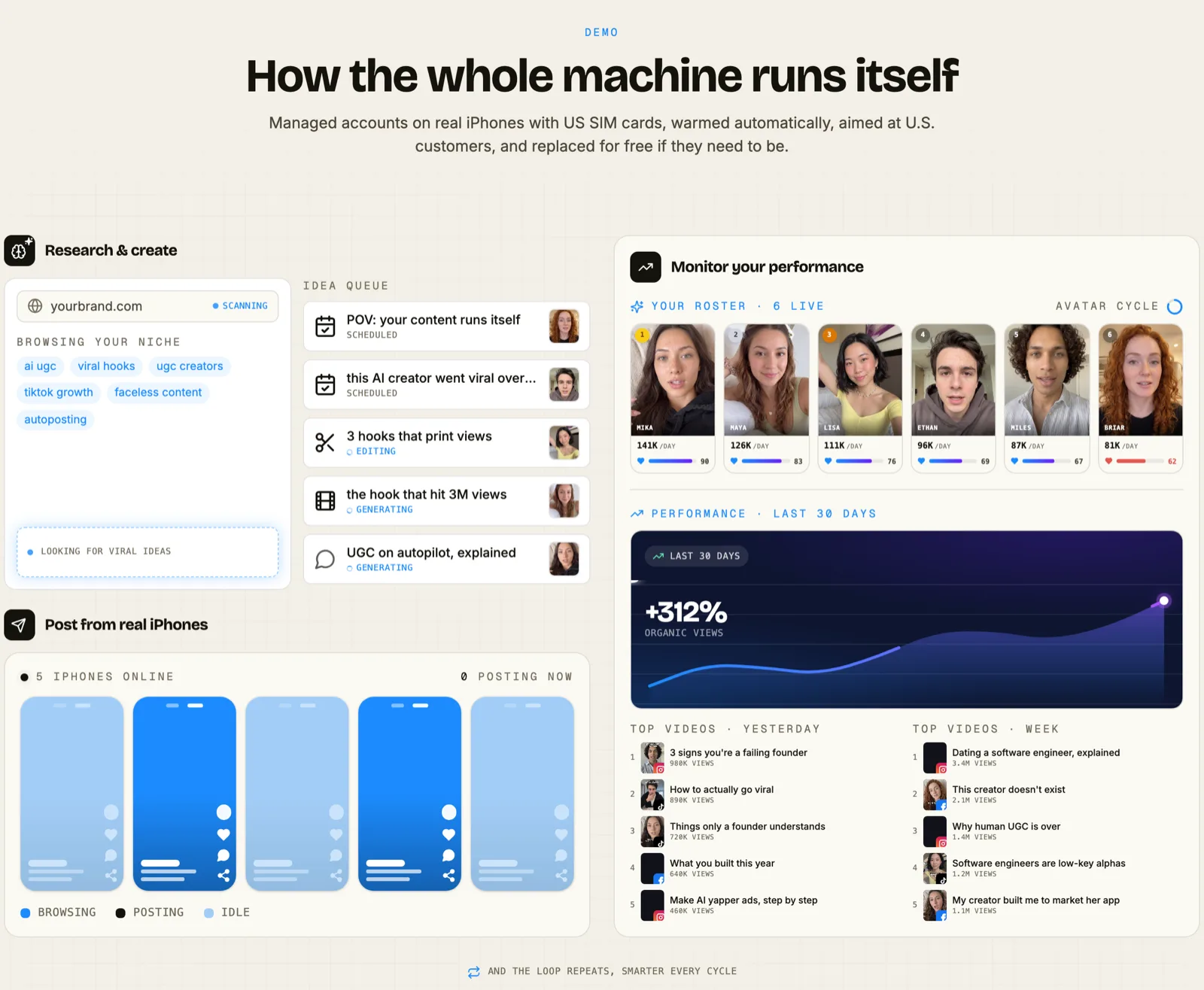
AI UGC is user-generated-style content made with AI avatars instead of human creators. The videos look like the organic, talking-to-camera clips that fill TikTok and Instagram feeds, but the person on screen is generated, the script is written (often by AI), and the whole pipeline runs without filming anyone.
Brands use it for the same reason they pay human UGC creators: native-feeling video consistently outperforms polished ads in short-form feeds. AI removes the two bottlenecks of the human version, sourcing creators and waiting on deliverables.
How does AI UGC actually work?
A modern AI UGC pipeline has four stages:
- Avatar creation. A consistent, realistic character is generated once and reused across videos, so an account builds a recognizable face over time.
- Scripting. Short-form scripts follow tight structures (hook in the first two seconds, one idea, one payoff). This is where most of the performance variance lives, and where pattern libraries beat improvisation.
- Video generation. The avatar performs the script: lip-synced speech, natural motion, b-roll cuts, captions, and text hooks.
- Distribution and analytics. Videos post to real accounts on a schedule, and per-video analytics feed back into what gets scripted next.
At Pamba we run the last stage from physical phones rather than APIs, because distribution behaves differently for content posted the way a person posts.
When does AI UGC outperform human UGC?
AI UGC wins on volume, consistency, and iteration speed. Testing twenty hook variations in a week is trivial with generated creators and nearly impossible with a human roster. It also wins on cost per video by a wide margin.
Human UGC still wins when the content depends on genuine product usage: hands-on demos, taste tests, before-and-after transformations. Most brands end up running both, with AI handling the high-volume top of funnel.
What makes an AI UGC video perform?
The same things that make any short-form video perform, executed consistently:
- The first two seconds. A verbal or visual hook that names the viewer's problem. Most videos die here.
- Watch time. Retention past the halfway point is the strongest signal the algorithms reward. Cut everything that does not earn its seconds.
- Native formatting. Captions, trending sounds where relevant, vertical crop, imperfect energy. Feed-native beats studio-polished.
- Volume with feedback. Accounts that post daily and adjust to their analytics compound; accounts that post four perfect videos a month stall.
Frequently asked questions
Is AI UGC allowed on TikTok and Instagram?
Yes. Both platforms allow AI-generated content and both provide labeling tools for it. What gets accounts in trouble is spam behavior (mass-posting identical content), not the use of AI itself.
Do viewers engage with AI avatars?
Yes, when the avatar is consistent and the content is genuinely useful or entertaining. Viewers follow characters and formats. Accounts built on a recurring AI creator with a clear niche routinely reach millions of views.
How much does AI UGC cost compared to human UGC?
Human UGC typically costs $50 to $300 per video, plus sourcing and management time. AI UGC platforms produce videos for a few dollars each at volume, which changes the economics of testing: you can afford to be wrong most of the time.
If you want to see what this looks like in practice, the demo walks through a real video being created, and pricing covers what running it costs.